
Acceptance of Dangerous Goods
Restrictions
Dangerous goods are divided into 3 categories:
-
Dangerous goods forbidden to be carried on an aircraft under any circumstances.
Any substance which, when offered for transport, is capable of exploding, undergoing dangerous reactions, igniting, or releasing dangerous amounts of heat or toxic, corrosive or flammable gases or vapours under normal conditions encountered during transport, shall not be carried on board aircraft under any circumstances.
Dangerous goods offered for transport in ULD
U6 do not transport dangerous goods on A319/320/321 aircraft using any type of ULD.
Dangerous goods acceptance procedures
Dangerous goods acceptance point
At cargo acceptance points the operator (or its authorised agent) must ensure that a sufficient number of notices containing information about the carriage of dangerous goods and a current edition of the IATA DGR or ICAO Technical Instructions (DOC 9284) are displayed in a prominent location.
Operator staff (or its authorised agent) involved in cargo acceptance must be properly trained so that they can recognise and detect dangerous goods offered as part of mixed cargo.
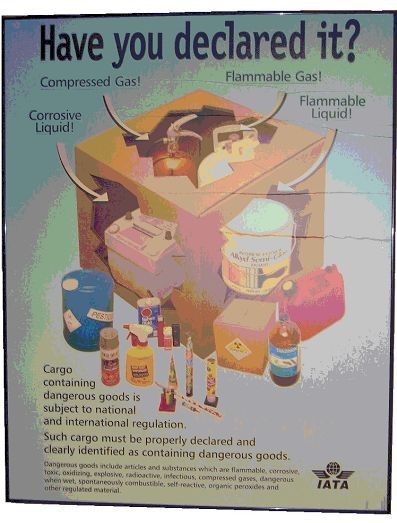
Identification and classification of dangerous goods
The shipper is responsible for the accuracy and completeness of the information that must be indicated in the Shipper’s Declaration for Dangerous Goods (hereinafter — the Declaration). The Declaration form is given in Appendix D1.1.
Requirements:
- The Declaration must be prepared and signed in two copies by the shipper or its agent in accordance with IATA DGR requirements (one copy is attached to the airway bill and accompanies the consignment to destination);
- The shipper’s declaration shall be completed in Russian. For international shipments, unless otherwise specified by the State of destination, the Declaration shall be completed in English;
- If information given in the declaration must be supported by Certificates, Authorisations, Licences or other documents attached to the declaration, they shall be drawn up in Russian. For international shipments, unless otherwise specified by the State of destination, they shall be drawn up in English;
- A contact telephone number must be provided for emergency situations, if required.
If these requirements are not met the completed declaration will not be accepted. A new declaration must be prepared if:
- Corrections in the declaration are not signed by the shipper or its agent in accordance with the IATA DGR rules (or signatures do not match);
- If the proper shipping name is not indicated in accordance with IATA DGR requirements;
- The declaration is completed incorrectly or insufficiently.
Application of hazard labels
Before handling and loading, the shipper or its authorised agent must have an endorsement on the dangerous goods declaration that the dangerous goods have been properly prepared for shipment. Packaging and documentation are also checked by the acceptance officer in accordance with the IATA Dangerous Goods Regulations.
All packages containing dangerous goods must be marked and labelled in accordance with the IATA Dangerous Goods Regulations so that they can be immediately identified at all stages of transport:
- All packages containing dangerous goods must show the proper shipping name and the name and address of the shipper and consignee;
- The shipper is responsible for labelling each package in the consignment with a sticker indicating the appropriate hazard class;
- If required, handling information must be shown on all packages as stickers or stamps, such as "CARGO AIRCRAFT ONLY" and "THIS WAY UP".
All dangerous goods acceptance points must have a sufficient supply of hazard labels and handling marks used on U6 flights.
Before moving dangerous goods from the storage area to the aircraft, authorised personnel must inspect and check all hazard labels. Any discrepancies must be reported immediately to the acceptance officer at the dangerous goods acceptance point. If any cargo piece containing dangerous goods is found to be in an unsatisfactory condition, it must not be loaded onto the aircraft.
If the operator discovers loss, improper securing or discrepancy of hazard labels for dangerous goods consignments, it must replace them with appropriate hazard labels taking into account the information provided in the dangerous goods transport document.
Note. When replacing labels, the airline’s authorised agent personnel must take into account the information contained in the declaration. In case of any uncertainties regarding the contents, the shipper should be contacted and labels replaced. Cargo without any marking or with insufficient marking should be treated as a dangerous goods incident.
Additional handling and storage marks
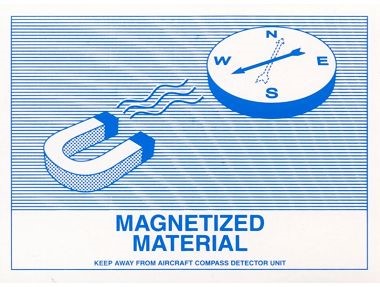
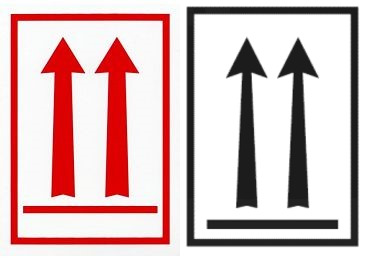
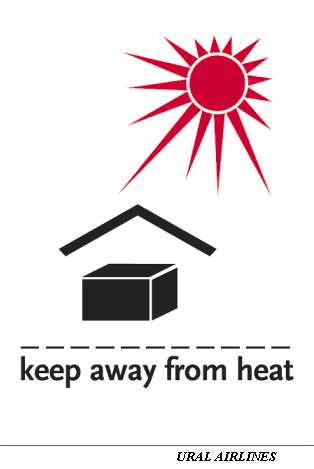
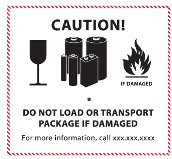
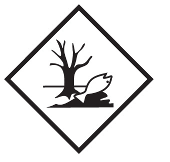
Note. The magnetized material label must be placed on all packages and outer packagings containing magnetized material according to this Manual. Additional marks must be used in addition to the corresponding hazard labels.
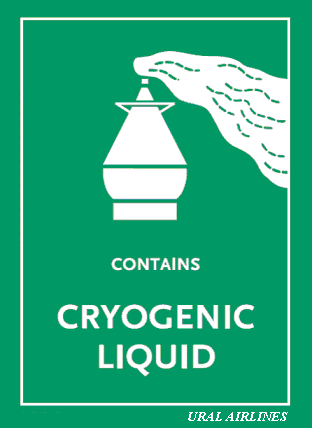
The "Cryogenic liquid" mark must be placed on all packages and outer packagings containing cryogenic liquids in addition to the RCL label and the placement mark. The "Keep in a cool place" mark must be placed on all packages and outer packagings that must be kept away from direct sunlight and heat sources — Class 4.1 and 5.2 and special provision A20. The "Placement of cargo unit" mark must be placed on all cargo units and outer packagings containing liquids according to this Manual. The "Dry Ice" label (or written information on the package) must be placed on all packages and outer packagings containing dry ice in addition to the RMD label.
Application of hazard labels
The airline’s authorised agent and the shipper are responsible for the correct marking of all cargo units, outer packagings and containers in accordance with the requirements of this Manual. The following procedure requires:
- Marking of each cargo unit, outer packaging or cargo container;
- The full and exact name of the shipper, the full proper shipping name and the UN number;
- UN code on the marked packaging;
- Other necessary marking required by this Manual.
Dangerous goods acceptance checklist
The Dangerous Goods Acceptance Checklist (hereinafter — the Check List) must be used when accepting dangerous goods.
The Check List must be used to verify cargo units, outer packagings and cargo containers against IATA requirements. Check Lists must be updated in accordance with IATA requirements. Personnel must use only updated IATA Check Lists.
Only specifically trained CHA / GHA personnel, trained to category 6 in accordance with IATA requirements, may accept dangerous goods using the Check Lists. Authorised agents may use either the Check Lists provided by Ural Airlines or Check Lists of any other format that comply with the IATA Dangerous Goods Regulations (current edition).
The Check List must contain information identifying the person who conducted the inspection at acceptance.
Personnel accepting dangerous goods have the right to accept them for carriage only after ensuring that the consignment:
- Is correctly marked;
- Has no damage or leakage.
The Check List form is prepared in 2 copies: the original is attached to the air waybill, the copy remains with the carrier.
If any question in the Check List is answered "NO", the consignment must not be accepted for carriage and the Check List must be retained for 3 months.
The Check List for radioactive cargo must be used for acceptance of radioactive consignments. The Check List form is given in Appendix D1.2.
The Check List for non-radioactive cargo must be used for acceptance of non-radioactive consignments. The Check List form is given in Appendix D1.3.
The Check List for Dry Ice must be used when accepting dry ice for transport (also for cargo units where dry ice is used as a refrigerant). The Check List form is given in Appendix D1.4.
Document retention
All documents for dangerous goods must be retained at the airport of departure for at least 3 months after the flight on which these dangerous goods were carried:
- Original Shipper’s Dangerous Goods Application;
- Copy of the Check List;
- Copy of the Air Waybill;
- All documents attached to the transport documents;
- Written information to the pilot-in-command (NOTOC).
In case of discrepancies/omissions/errors made by the shipper (in marking, packing, documentation) discovered during the dangerous goods acceptance control, documentation recording these discrepancies (Acceptance Control Card for DG / Check List) must be kept at the airport of departure for at least 3 months after all discrepancies have been corrected and a control acceptance of the DG has been carried out.
Acceptance of motorcycles and automobiles
Motorcycles, automobiles and engines are accepted in accordance with IATA requirements.
Acceptance of lithium batteries and lithium-ion batteries for transport
On Ural Airlines flights, Lithium batteries and lithium-ion batteries are accepted as dangerous goods when assigned UN number 3091 — Lithium batteries contained in equipment, UN 3091 — Lithium batteries packed with equipment, UN 3481 — Lithium-ion batteries contained in equipment, UN 3481 — Lithium-ion batteries packed with equipment in accordance with the list and rules of IATA DGR and permitted for carriage on a passenger aircraft.
Dangerous goods in limited quantities
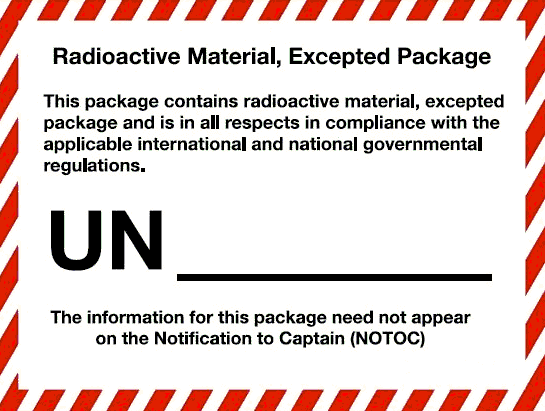
For dangerous goods in limited quantities and radioactive material in exempted packaging as defined in IATA DGR, a Shipper’s Declaration, Check List, and NOTOC and loading instructions are not required. Such cargo units must bear the following marks filled in accordance with IATA DGR requirements.
Goods forbidden for air transport under any circumstances
Goods forbidden for air transport under any circumstances (extremely dangerous) include articles and substances specifically listed in the DG List by name as forbidden for air carriage under any circumstances (instead of assigning a UN number); they are not carried on aircraft of any type.
Because it is impossible to provide a complete list of such DG, the following types of substances or articles are included:
- Explosive substances that ignite or decompose at 75°C within 48 hours;
- Explosive substances containing mixtures of chlorates with phosphorus;
- Solid explosive substances classified as having extremely high sensitivity to mechanical shock;
- Explosive substances containing both chlorates and ammonium salts;
- Liquid explosive substances classified as having moderate sensitivity to mechanical shock;
- Any substance or article offered for transport that is capable of releasing dangerous quantities of heat or gas under normal conditions of air transport;
- Flammable solids and organic peroxides capable of exploding and packaged in such a way that, according to classification rules, the explosion hazard label must be used as an additional risk label.
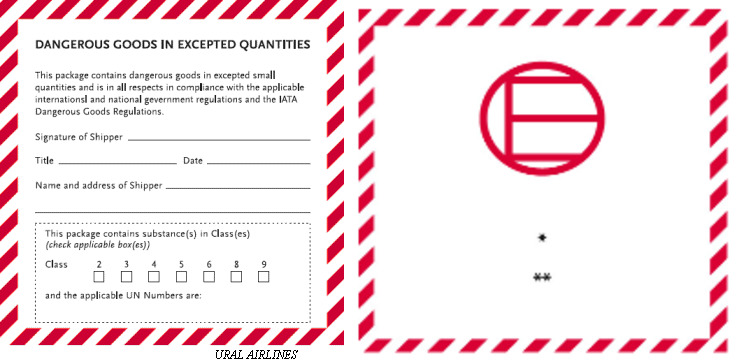
Acceptance of extremely dangerous goods
Acceptance of extremely dangerous goods for carriage by aircraft, as specified in the Technical Instructions, is carried out only after the operator has received confirmation from the shipper and the consignee of readiness to dispatch and accept the extremely dangerous goods, and after confirmation of readiness to accept and handle the extremely dangerous goods at all airports of landing along the aircraft’s route.
Dangerous goods not accepted for carriage by aircraft
All dangerous goods are not accepted for carriage by aircraft if:
- The dangerous goods are not accompanied by a Shipper’s Declaration for Dangerous Goods, except where the ICAO Technical Instructions state that such a document is not required;
- Without inspection of the cargo unit, outer packaging or cargo container containing dangerous goods in accordance with the procedure established in the ICAO Technical Instructions;
- Packing sets are not protected and not provided with cushioning to prevent damage to packing sets, leakage of dangerous goods and to ensure control of their movement inside the outer packaging under normal conditions of air transport of dangerous goods;
- Marking, hazard labels and packaging do not comply with the Technical Instructions (Doc 9284 AN/905 ICAO);
- Cargo units, outer packagings and cargo containers have leaks or damage.